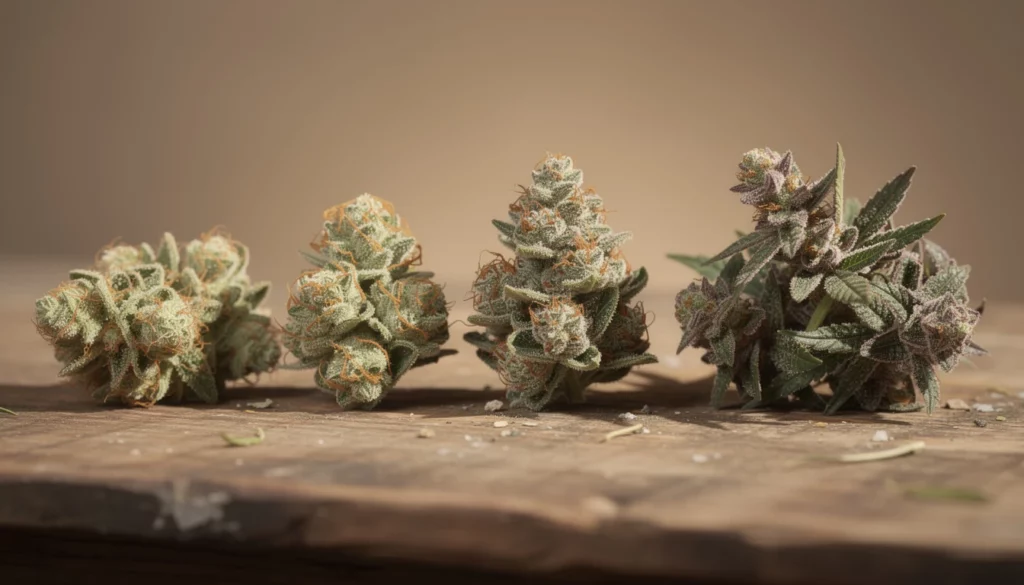
The skunk occupies a unique place in the history of cannabis and its cultural evolution, from the initial experimentation in genetic selection to its recent adaptation to the legal CBD market. By looking at the fascinating journey of this iconic strain, we discover how a simple crossbreeding of strains has profoundly influenced cannabis culture, consumption habits, and even opened the door to modern CBD flowers that comply with regulatory frameworks.
The origins of skunk: the birth of a revolutionary strain
The history of skunk begins in the 1970s, a pivotal time for cannabis genetics. At that time, amateur and pioneering growers sought to improve both the potency, yield, and stability of plants. The ambition was clear: to combine in a single plant the best of strains from India, Afghanistan, Thailand, and Mexico.
Thus, the crossbreeding of indica and sativa strains led to the creation of an innovative hybrid, signaling the birth of the famous skunk. The name “skunk” refers to the powerful and pungent aroma emanating from the flowers, evoking the skunk, an animal known for its characteristic smells. To learn more about this term and its history, discover the precise definition of cannabis skunk.
The rise of skunk in the 1980s and 1990s
From its inception, skunk experienced rapid adoption among enthusiasts of cannabis culture. Recognizable by its intense odor, early flowering, and vigor, it quickly became indispensable in breeder circles and among discerning consumers.
- Rapid flowering compared to traditional strains
- Increased resistance to diseases and variable conditions
- Distinct sensory profile, often described as musky, sweet, and earthy
- Balanced effect derived from its hybrid genetic makeup
During this period, skunk inspired many other crosses, giving rise to an entire family of powerful hybrid strains. Among these, super skunk stands out as a direct descendant and a symbol of genetic refinement, enhancing resin content and aroma intensity. Moreover, the origin of the term makes complete sense when considering how the skunk aroma distinguishes these strains.
Having become synonymous with innovation, the term skunk eventually came to denote, in the collective imagination, any cannabis with a rich olfactory profile created through intensive crossbreeding of different strains.
From genetic origins to modern cultivation: skunk in the wellness world
While skunk has long been associated with recreational uses, its unique genetics are now attracting attention in the CBD flower sector. New crosses aim to retain production advantages—robustness, yield, aromatic profile—while ensuring a THC level that meets current legal requirements.
The genetic origins of skunk offer several valuable advantages, even in the current CBD-oriented cultivation. The ease of growing, the speed of the flowering cycle, and overall resistance simplify the work for both small producers and larger, more ambitious operations.
In terms of CBD flower, skunk often serves as a base for hybrids that combine effectiveness, pronounced flavor, and cultural accessibility. A comparative table helps to grasp its specificities relative to other major classics of cannabis.
| Characteristic | Skunk | Classic strain |
|---|---|---|
| Flowering duration | Short to medium | Long |
| Ease of cultivation | High | Medium to low |
| Aroma | Pungent, musky | Herbaceous, woody |
| CBD adaptation | Excellent | Variable |
The role of crossings in the evolution of CBD flowers
Breeders have continuously played with crossbreeding of strains to enrich the palette available on the CBD market. Each hybrid born from skunk aims to convey its resistance and distinct aroma without sacrificing the legal THC content. This meticulous process requires expertise, patience, and scientific rigor to obtain a stable and effective flower.
Modern hybrids derived from skunk share several strengths, such as a beautiful density of trichomes, a compact structure, and a diversity of effects depending on their indica or sativa dominance. Many of them now occupy specialized shelves thanks to this know-how, becoming essential in the new legal cannabis culture.
A lasting influence on the entire cannabis and CBD industry
Over the decades, the popularity of skunk has only grown. Its legacy can be found everywhere, from private collections of enthusiasts to professional catalogs. Several aspects explain this ongoing enthusiasm:
- Versatility of aromatic and flavor profiles
- Ease of cultivation suitable for all environments
- High yields facilitating access to competitive prices
Between history, cannabis culture, and modernity, skunk remains a bridge between ancient practices and the demands of a broader and more diverse audience. Its transformation into CBD flower adapted to legislation also allows for reaching new consumer profiles, particularly those seeking relaxation, calm, or support for well-being without major psychotropic effects.
Thus, the influence of skunk transcends the strict framework of traditional cannabis, actively contributing to the growth of the CBD market and the positive dynamics surrounding naturally derived cannabinoids.
Frequently asked questions about skunk and its history
What are the main characteristics of skunk?
- Hybrid resulting from a cross of indica and sativa strains
- Powerful, musky, and sometimes acrid odor
- Fast flowering and good yield
- Stable genetics, suitable for different climates
Why is skunk important in the development of CBD flower?
How has skunk evolved since the 1970s?
| Period | Main use |
|---|---|
| 1970s-80s | Crossbreeding for potency and aroma |
| 2000s | Selections for medical and then CBD purposes |
What is the difference between skunk and super skunk?
- Super skunk: increased potency, more complex aroma
- Original skunk: typical scent and genetic balance

Alexandre Lacarré is recognized as an innovative and influential leader in the cannabidiol (CBD) industry. Alexandre began his career in the biotechnology sector, where he gained valuable expertise in research and development. Passionate about the therapeutic potential of natural compounds, he quickly shifted his focus to the nascent CBD industry.